


The Comfortable Collapse: Canada’s Decade of Managed Decline
Originally via @JoeyTweeets on X
There is a concept in ecology called a “shifting baseline.” It describes what happens when each generation accepts the degraded state of its environment as normal, because no one can remember what things looked like before the decline began. The fisherman’s son thinks a small catch is a good catch because he never saw the ocean his grandfather fished.
Canada is living through a shifting baseline. Not a dramatic collapse. Not a sovereign debt crisis or a currency peg breaking in the night. Something quieter, and in many ways worse: a country getting slowly, structurally poorer, and rearranging its national mythology fast enough that most people haven’t noticed.
The numbers tell a story that the political class, across every party, has spent a decade trying not to say out loud. So let me say it plainly: Canada has been in structural economic and social decline since approximately 2015, and nearly every major indicator of national health has moved in the wrong direction. The question is no longer whether the decline is happening. It’s whether the decline is reversible.
The Productivity Death Spiral
Start with the most damning chart in Canadian economics, the one that should be taped to the wall of every MP’s office in Ottawa: GDP per capita.
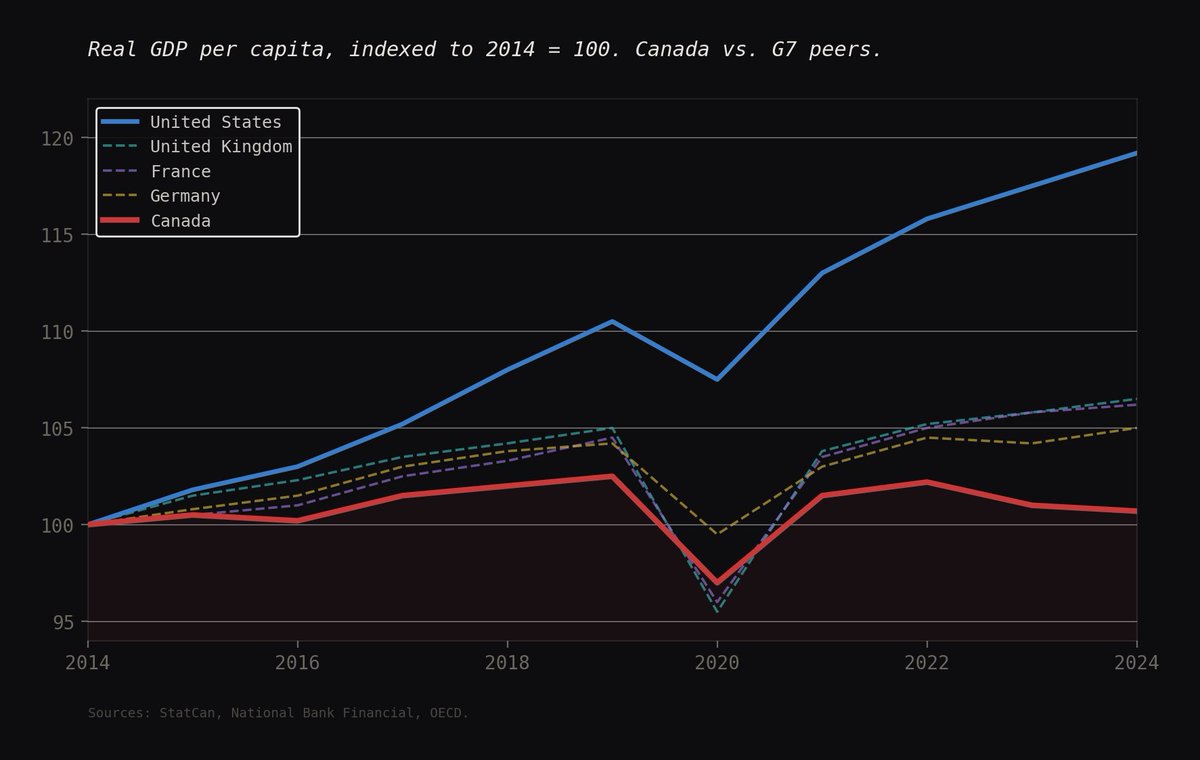
A representative Canadian today produces roughly what they produced in mid-2014. That’s not a typo. Over the same period, the average American saw cumulative output growth of more than 16%. Germany, the next-weakest G7 economy, managed over 5%. Canada sits dead last. Flat. A lost decade, measured and documented by the Bank of Canada, the OECD, TD Economics, National Bank, and the C.D. Howe Institute, among others. This is not a fringe narrative. It’s the institutional consensus.
The mechanism behind the stagnation is brutal in its simplicity. Business investment in machinery, equipment, and intellectual property has been in retreat since 2015. Adjusted per-worker investment in the third quarter of 2025 was roughly $15,000 in 2024 dollars, down nearly a quarter from its 2014 peak of $19,400. Real spending on machinery and equipment currently sits below levels recorded in 2008. Canada’s stock of M&E, the actual physical tools and assembly lines and robots that drive output, declined 4.6% over the past decade, from roughly $370 billion to $353 billion in constant dollars. While the machines aged and the factory floors emptied, the US saw investment per worker rise by more than 26% over the same period.
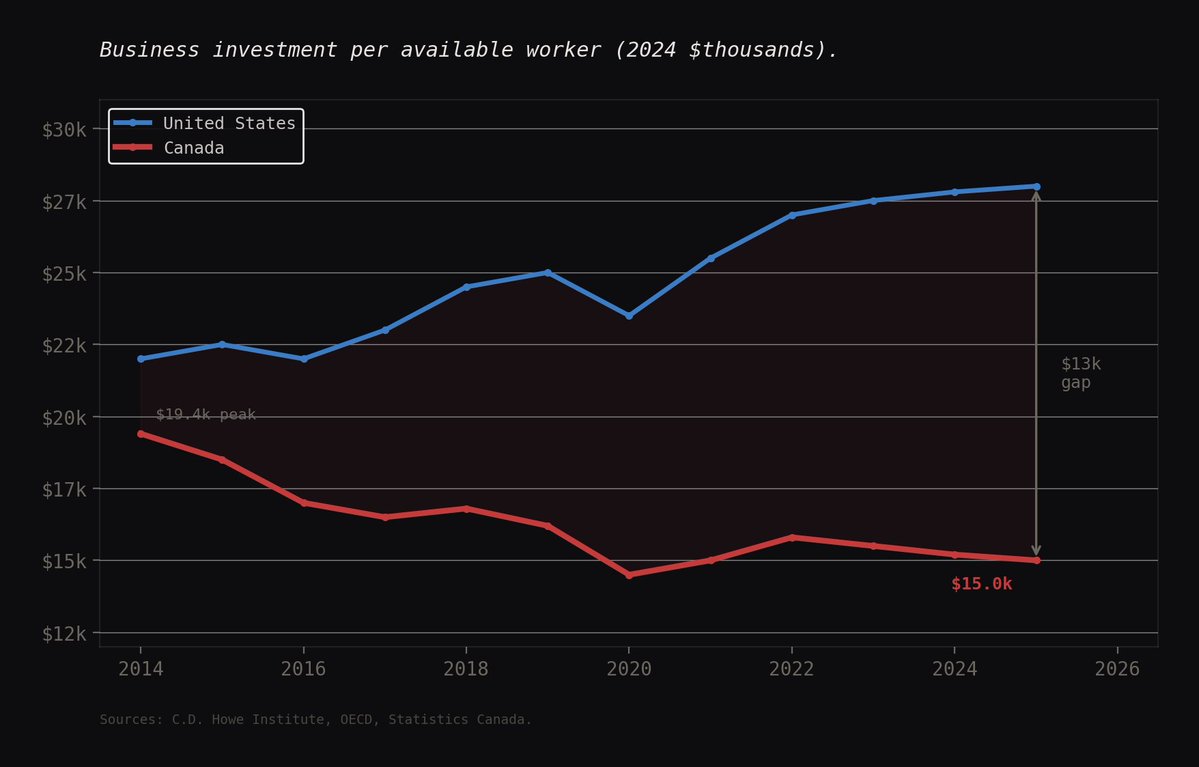
The comparisons with the United States are particularly savage. Canadian workers now receive just 41 cents of new M&E investment for every dollar their American counterparts receive, down from 47 cents in 2015. In intellectual property products, the software, patents, and R&D that define competitiveness in any modern economy, the figure is 32 cents on the dollar. Canada invests just 3.4% of its gross value added in IP products, roughly half the American rate of 6.6%. These are not numbers that describe a peer economy. They describe a country that has quietly opted out of the technological competition.
Canada’s R&D spending has been in perpetual decline for over twenty years, while every other G7 country has seen increases. The OECD projects Canada’s average annual growth rate for GDP per capita through 2060 to be the lowest among 30 advanced economies. Not the lowest growth rate this year, or this decade. The lowest projected growth rate among developed nations through 2060. The institutional bet is that Canada’s relative decline is not a blip but a trajectory.
Where did the investment go? Into real estate. In 2022, 38% of Canada’s gross fixed capital formation was directed toward housing, the highest fraction in the OECD. Germany was second at 33%. Every other country was below 30%. Canada chose houses over factories, speculation over production, and the bill is now arriving in the form of a productivity gap with the United States that has widened from 88% to 71%. By 2024, Canada generated about $143,000 of output per available worker, compared with almost $200,000 in the United States.
The Bank of Canada’s own deputy governor called it a “productivity emergency” in 2024. By late 2025, the Bank devoted a full speech to the problem, warning that Canada was caught in a “vicious circle” where weak investment begat weak productivity which begat weak wages which begat weak investment. When your central banker is using the word emergency and talking about vicious circles, you are well past the point of polite concern. And when their proposed solution is essentially to hope that adversity catalyzes action, you know the institution has run out of ideas.
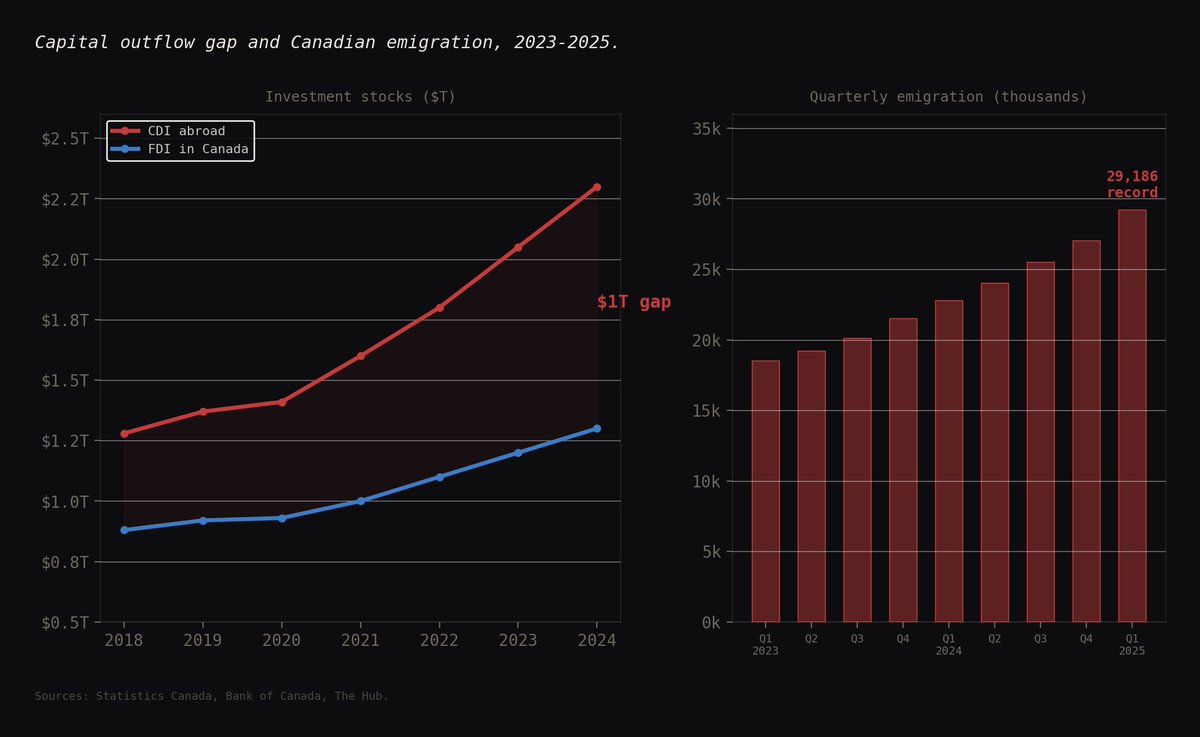
Meanwhile, foreign direct investment tells its own story. By the end of 2024, Canadian direct investment abroad outpaced foreign direct investment in Canada by nearly $1 trillion. In a single month in 2024, investors poured a record $14.2 billion into US equities while foreign investors sold $11.4 billion in Canadian shares. Capital doesn’t have a nationality. It goes where returns are highest and risk is lowest. And it has been leaving Canada for a decade.
The Population Experiment
To understand what happened to the denominator in Canada’s per-capita math, you have to understand the scale of what was attempted.
In 2023, Canada’s population grew by 3.2%, an increase of 1,271,872 people. That is roughly the size of Calgary, added in a single year. It was the highest growth rate since 1957, and 97.6% of it came from immigration. The following year added another 744,000. By January 2025, the population stood at 41.5 million, with approximately 2.7 million non-permanent residents living in the country.
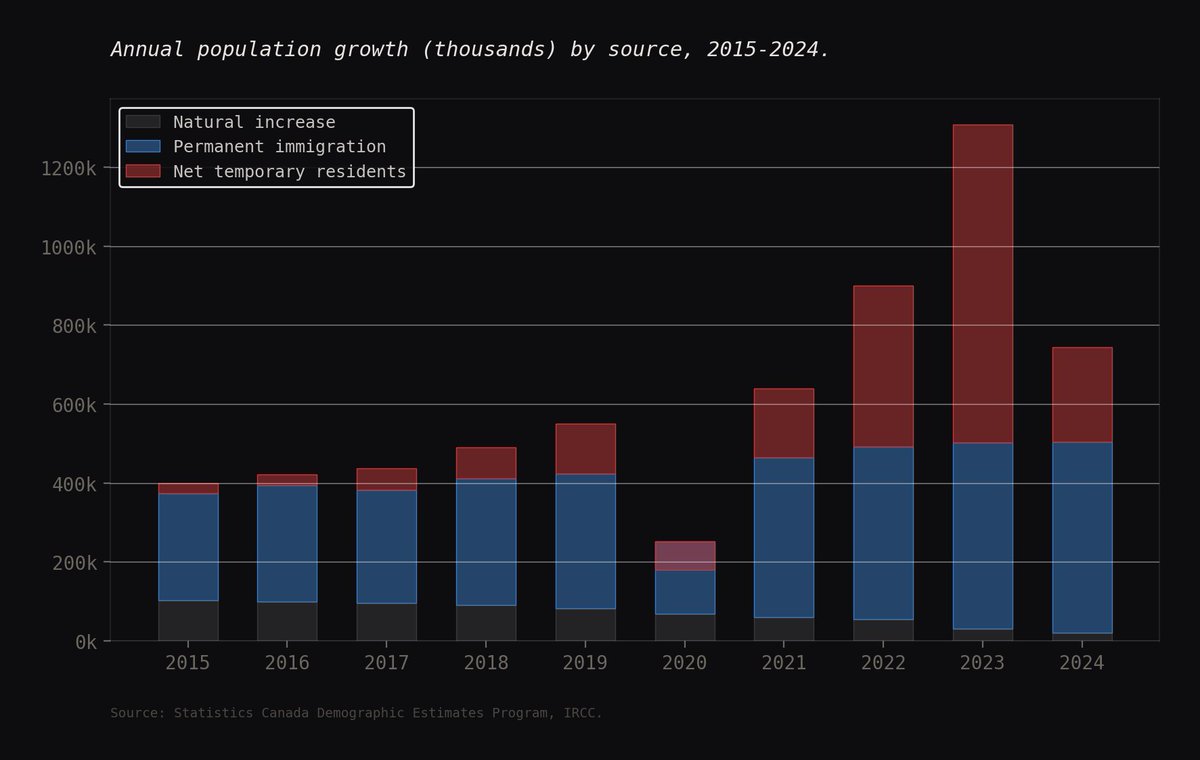
These growth rates have, as one demographer noted, “never been seen in a developed country” since the 1950s. What makes the Canadian experiment distinct is not just the velocity but the composition. Two-thirds of the non-permanent arrivals came on temporary work or student visas. The international student pipeline, in particular, became a shadow immigration program: institutions facing declining domestic enrollment and reduced public funding began relying on international students whose tuitions were more than five times higher than domestic rates. The 20-hour weekly work limit was lifted entirely in 2022 and only reinstated (at 24 hours) in 2024, after public pressure made the arrangement untenable.
The result was a labor market flooded at the low end. Thousands of international graduates found themselves in a country with no clear pathway to permanence, working multiple part-time jobs in food service and retail, paying rents that consumed most of their income, and in many cases ending up at food banks. The system promised them a future in Canada and delivered precarity. It promised Canadian workers a growing economy and delivered wage suppression.
The apologists will tell you that headline GDP kept growing, and that’s true. Canada posted the second-fastest aggregate GDP growth among G7 economies over the past decade. But GDP is not GDP per capita, and the gap between the two is where the lived reality of Canadians hides. You can grow your economy 2% by adding 3% more people. The math just means every individual got poorer. And that’s precisely what happened.
Budget 2025 proposes cutting temporary immigration from 673,650 in 2025 to 385,000 in 2026, with permanent immigration stabilizing around 380,000. This is an acknowledgment that the experiment failed. But the damage has been done: the housing deficit accumulated, the healthcare system was overwhelmed, and per-capita GDP fell for three consecutive years. You can’t un-break these systems by moderately reducing the rate at which you add people to them.
Housing as a Wealth Destruction Machine
The housing numbers in Canada are so far removed from any rational economic relationship to incomes that they almost resist analysis. In Toronto, a median household would need to devote 77% of its income to cover ownership costs at the benchmark price. In Vancouver, affordability recently touched 30-year worsts. Development charges alone add over $180,000 to the cost of a single-family home in Toronto and Markham, over $135,000 in Mississauga, and more than $113,000 in Coquitlam. These are not prices. They are barriers to entry, designed by incumbents to protect asset values.
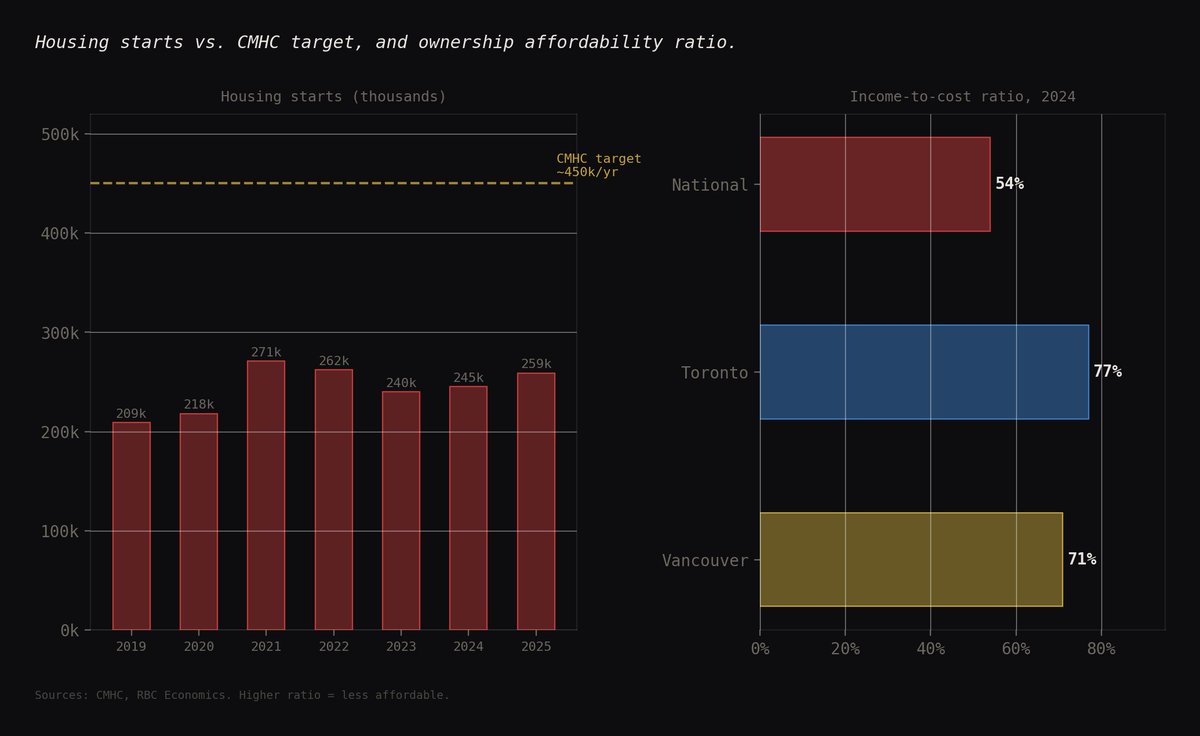
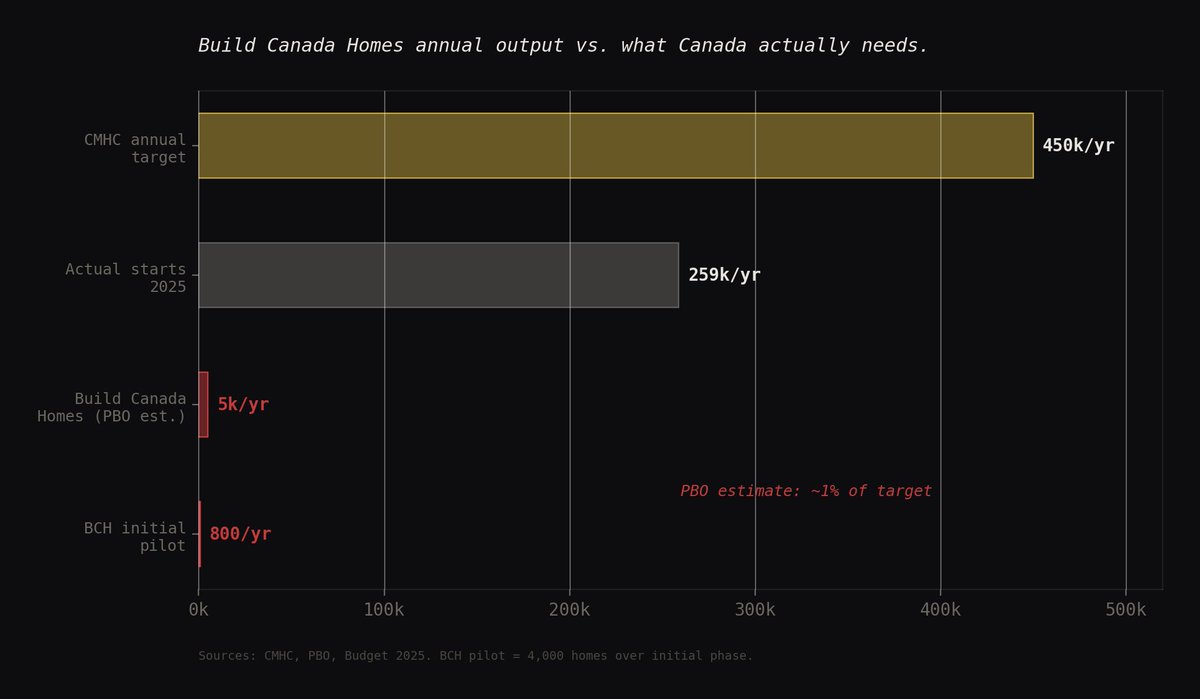
Canada has the lowest number of dwellings per capita in the OECD. This is not a new development. But the gap between demand and supply exploded after 2022 when the population began growing by a million or more per year while housing starts flatlined. In 2025, Canada started 259,028 homes, the fifth-highest total on record, which sounds encouraging until you realize that CMHC estimates roughly 430,000 to 480,000 new homes need to be built annually through 2035 to restore affordability. Canada has never come close to this number. Not once. Not in any year since Confederation. And even the 259,000 figure masks a deteriorating picture: Toronto starts fell 31% year-over-year, and CMHC’s own chief economist warned that construction momentum has been fading since September, with the trend entering 2026 from a weaker position.
The result is a generational wealth transfer from young to old that has rewritten the social contract. 70% of Canadians now say homeownership is impossible. Among millennials, almost half have considered delaying starting a family because they can’t afford a suitable home, and nearly a third would consider leaving the country entirely to find affordable housing. When your housing market is driving emigration, you’ve moved beyond a policy failure into something closer to an institutional betrayal.
Meanwhile, 56% of Toronto condos and 48% of Vancouver condos are investor-owned. Canada’s pension funds, including CPP and OTMH, own residential rentals across the country. The system doesn’t just fail to house its citizens. It actively profits from their inability to be housed. For every home built under government-funded programs, Canada loses 11 affordable rental units to rent increases, demolitions, and conversions. The country is running to stand still and losing ground.
The Healthcare Collapse in Slow Motion
The healthcare system that Canadians have historically cited as the core justification for higher taxes and slower growth compared to the United States is disintegrating in real time.
The Fraser Institute’s 2025 report recorded a median wait time of 28.6 weeks from GP referral to treatment across 12 medical specialties. That’s the second-longest wait ever measured. Wait times have increased 198% since 1993, three decades of consistent deterioration. This is not a system under stress. It is a system in secular decline, its trajectory as consistent and predictable as a demographic curve.
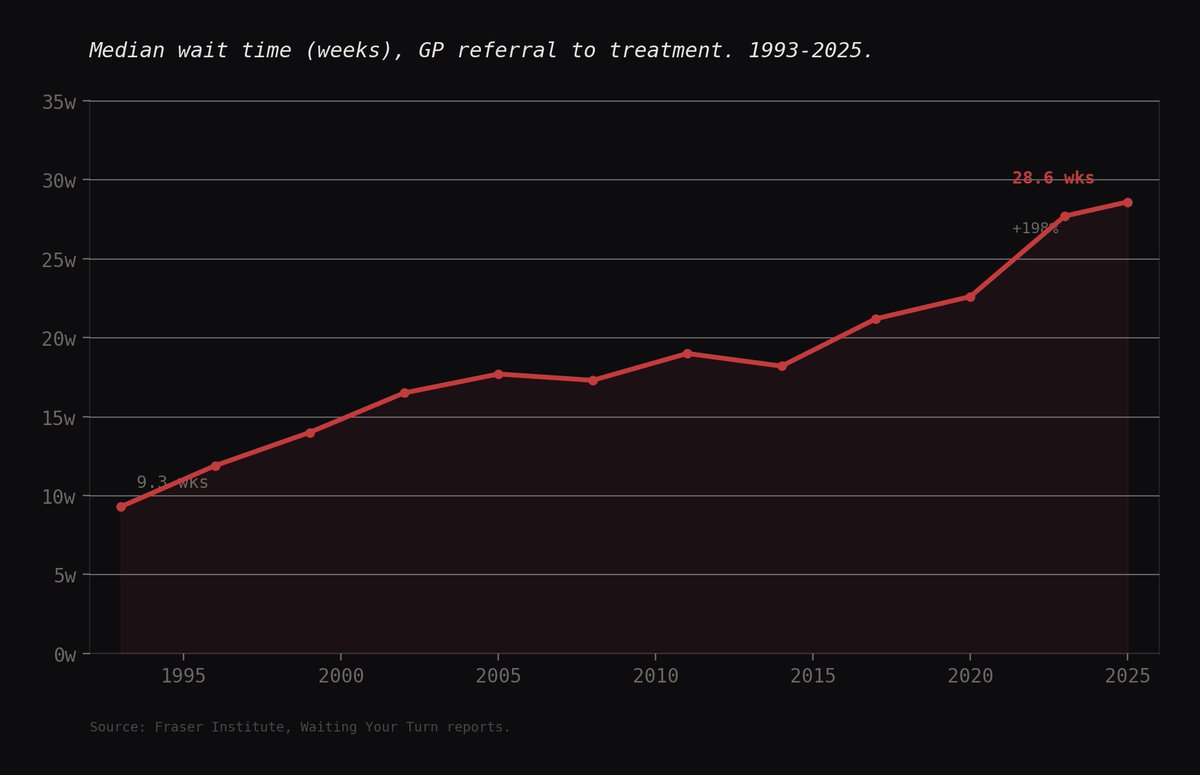
Half a million Canadians left emergency departments without being seen by a doctor in 2024. In Ontario, average ER wait times hit 20 hours, with some hospitals reporting 25 hours or more. 16.1 million unscheduled ER visits were recorded nationally in 2024-2025, up from 15.5 million the prior year. Among universal healthcare countries, Canada has some of the lowest numbers of physicians, hospital beds, and MRI machines per capita. Rural communities are watching their emergency departments close outright due to staffing shortages.
The system was built for 25 million people. It now serves 41.5 million and has not been meaningfully restructured. The population grew by 30% since 2000. Hospital capacity did not. And the wait-time data captures only the people still in the system. It doesn’t count the Canadians who gave up waiting for a referral, who drove across the border for an MRI, who paid out of pocket for a procedure their taxes were supposed to cover, or who simply learned to live with a condition that in any other developed country would have been treated months ago.
The Food Bank Indicator
If you want a single data point that captures the lived reality of Canada’s decline, here it is: food bank usage has doubled nationally since 2019.
2.2 million Canadians visited food banks in March 2025, the highest number ever recorded. Food Banks Canada titled its 2025 report “Food Banks as a Lifeline: Canada’s New Normal.” That word, normal, is doing a lot of heavy lifting.
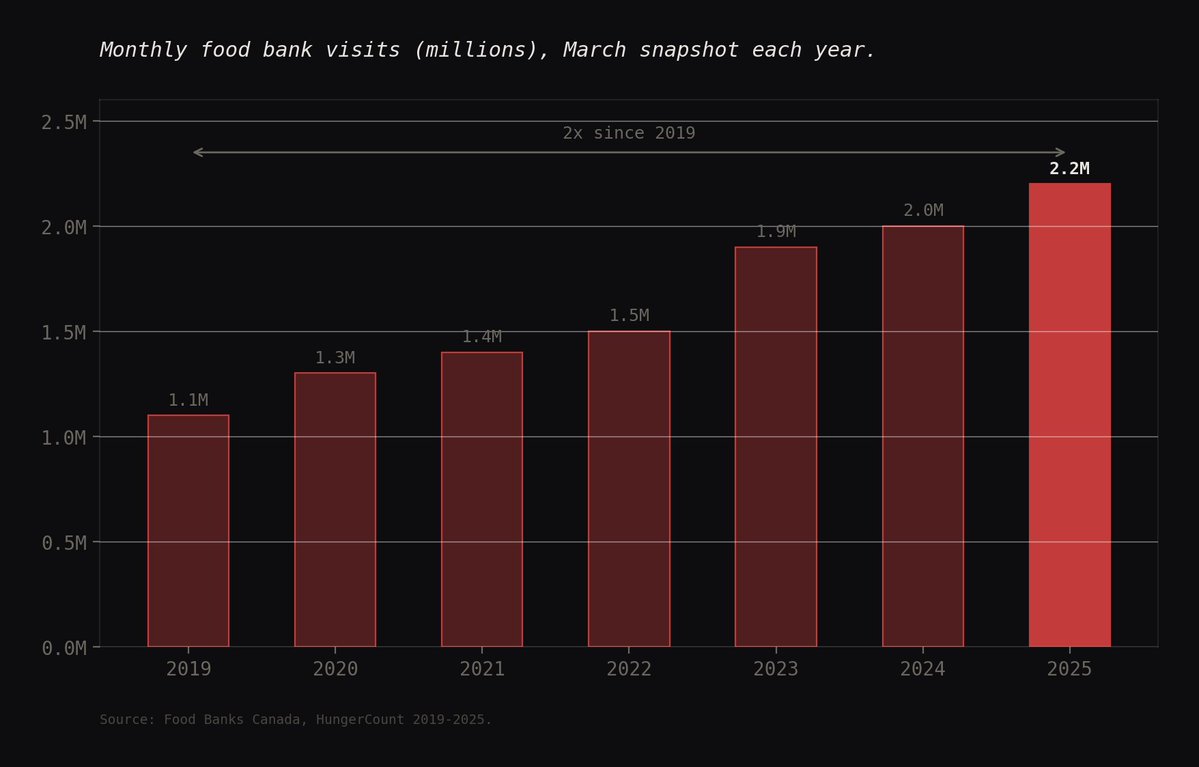
One-third of food bank clients are children, representing nearly 712,000 monthly visits. One in five food bank clients is employed. In 2019, it was one in eight. Employment is no longer a reliable buffer against poverty in Canada. The cumulative CPI increase since 2021 is over 18%, with shelter up 26% and food up 25%, while wages have not kept pace, especially at the bottom.
34% of food bank clients are newcomers who have been in the country for 10 years or less. This is not a condemnation of newcomers. It’s a condemnation of a system that brings people in at a rate it cannot absorb, fails to provide affordable housing or adequate social services, and then acts surprised when those people end up at a food bank. The cruelty is the system, not the people caught in it.
In Ontario alone, food bank visits hit 8.7 million between April 2024 and March 2025. That’s a 165% increase from 2019-2020. The ninth consecutive year of growth. Half the province’s food banks worry they won’t have enough food to meet demand, and two-thirds are concerned about sustaining operations over the next six months.
The Pension Gap and The Senior Poverty Trap
The maximum monthly CPP payment for someone starting their pension at age 65 is $1,433. The average new beneficiary receives $808 per month. Roughly 6% of recipients get the maximum.
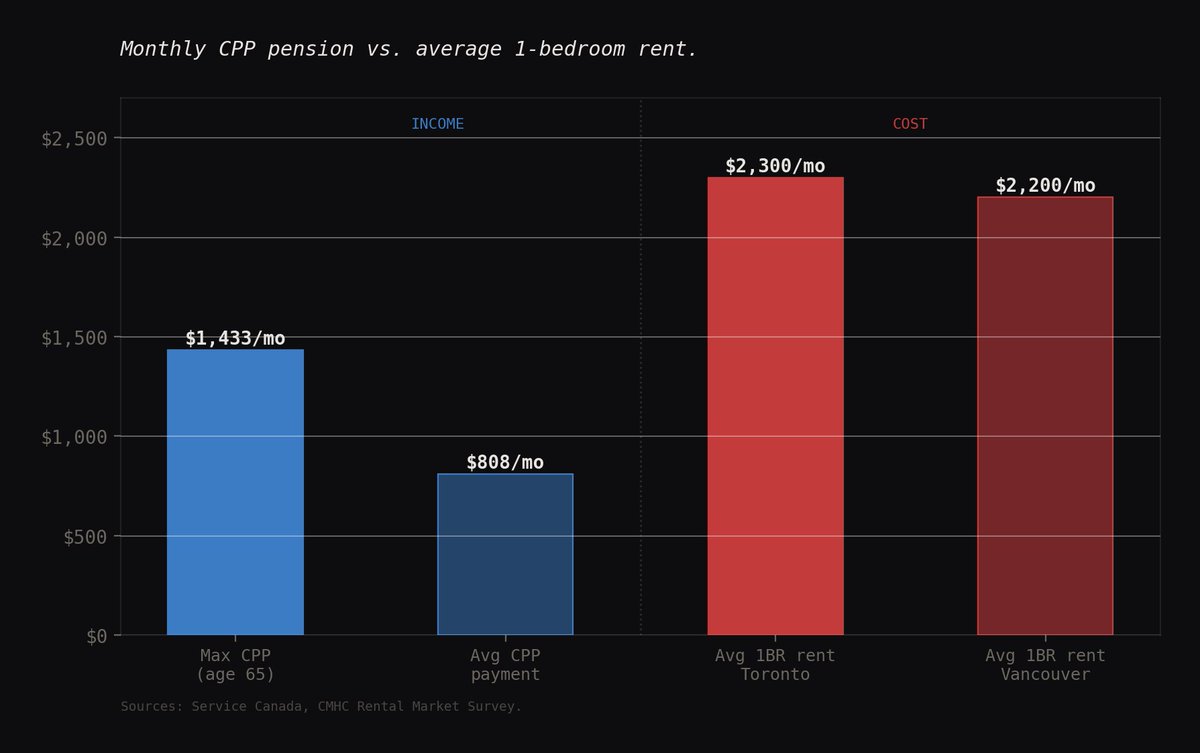
Let that sit for a moment. The average Canadian retiree collects about $9,700 per year from the pension system they paid into for their entire working life. In a country where the average one-bedroom rental in Toronto or Vancouver exceeds $2,000 per month.
CPP payments are indexed to CPI, which sounds reasonable until you realize that CPI systematically underweights the things seniors actually spend money on: healthcare, food, housing, and transportation. Grocery prices are still 25% higher than prepandemic levels. The 2% CPP adjustment for 2026 doesn’t even cover the cost of the food inflation seniors experienced in the previous year, let alone the cumulative damage.
Senior poverty had been declining for years, reaching a low of 3.1% in 2020. It’s now climbing again, hitting 5.0% in 2023. Seniors advocacy groups report that retirees are turning down the heat in their homes, buying expired food at discount, and cutting back on social activities because they can’t afford transportation. Less than 40% of Canadian workers have access to a workplace pension plan. In the private sector, it’s under 25%. For young workers, 13%.
The system is structurally incapable of providing a dignified retirement for the majority of Canadians. This was a known problem a decade ago. Nothing was done.
The Brain Drain and the Talent Exodus
A record 29,186 Canadians permanently emigrated in the first quarter of 2025 alone. Over 70% of graduates from the University of Waterloo’s elite software engineering program leave for the United States. A 2018 study found that one in four STEM graduates from Canada’s top three universities left the country, with 81% going to the US.
The reason isn’t complicated. The same software engineer can earn roughly double the compensation in the US, pay lower taxes, and live in a city where housing costs are often more reasonable relative to income than Toronto or Vancouver. Canada creates AI researchers at a world-class level and then watches them walk across the border to build companies that compete against Canadian firms.
The Globe and Mail diagnosed it precisely: Canada is becoming a “sophisticated rentier nation.” It’s a polite way of saying the country is transforming from a workshop into a counting house, living off the returns of capital deployed elsewhere because the domestic environment is too regulated, too expensive, and too uncompetitive to justify investing at home. The country exports talent and imports labor. It exports capital and imports consumption. These are the trade patterns of decline, not growth.
The Demographic Cliff
And then there’s the birth rate, which at this point reads like a biological verdict on the country’s economic management.
Canada’s total fertility rate hit 1.25 in 2024. That’s well below the replacement threshold of 2.1 and deep in “ultra-low fertility” territory, alongside Japan, Italy, and South Korea. British Columbia recorded 1.02, which is to say that the average woman in Canada’s third-largest province is having roughly one child. Nine of ten provinces and three territories recorded their lowest fertility rates ever in 2024.
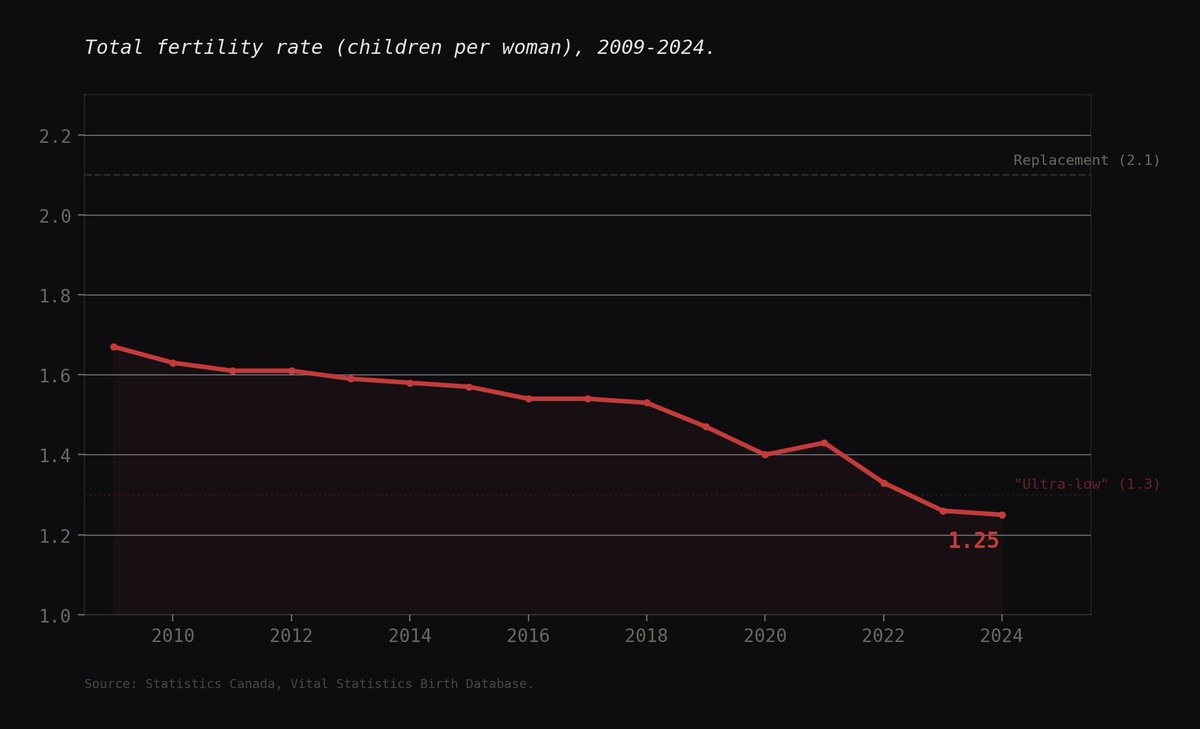
Half of Canadians under 50 who want children say they’ve delayed having them longer than they intended. Among those aged 35 to 44, the figure is 74%. The primary reason is cost. Housing, childcare, general economic insecurity. When a society makes it economically irrational to have children, people stop having children. This is not a mystery. It’s an incentive structure producing its predictable result.
The country’s response has been to replace domestic births with immigration. In 2021, for the first time, the number of immigrants arriving annually exceeded the number of domestic births. By 2024, more than two in five newborns had a foreign-born mother. The dependency on immigration to maintain population has become so total that any disruption to inflows would cause an immediate fiscal crisis in pension and healthcare funding.
This is not a sustainable model. It is a Ponzi demographic structure that requires ever-increasing inputs to avoid collapse, while doing nothing to address the underlying conditions that made domestic family formation unaffordable in the first place.
The Homelessness Explosion
The final indicator, and perhaps the most visible: nearly 60,000 Canadians were experiencing homelessness on a single night in late 2024. That number has almost doubled since 2018. The proportion sleeping in unsheltered locations, including encampments, grew from 14% to 28% over the same period. Among those who have experienced homelessness, 28% had also experienced an eviction, with disproportionate impacts on Indigenous, Black, and other racialized communities.
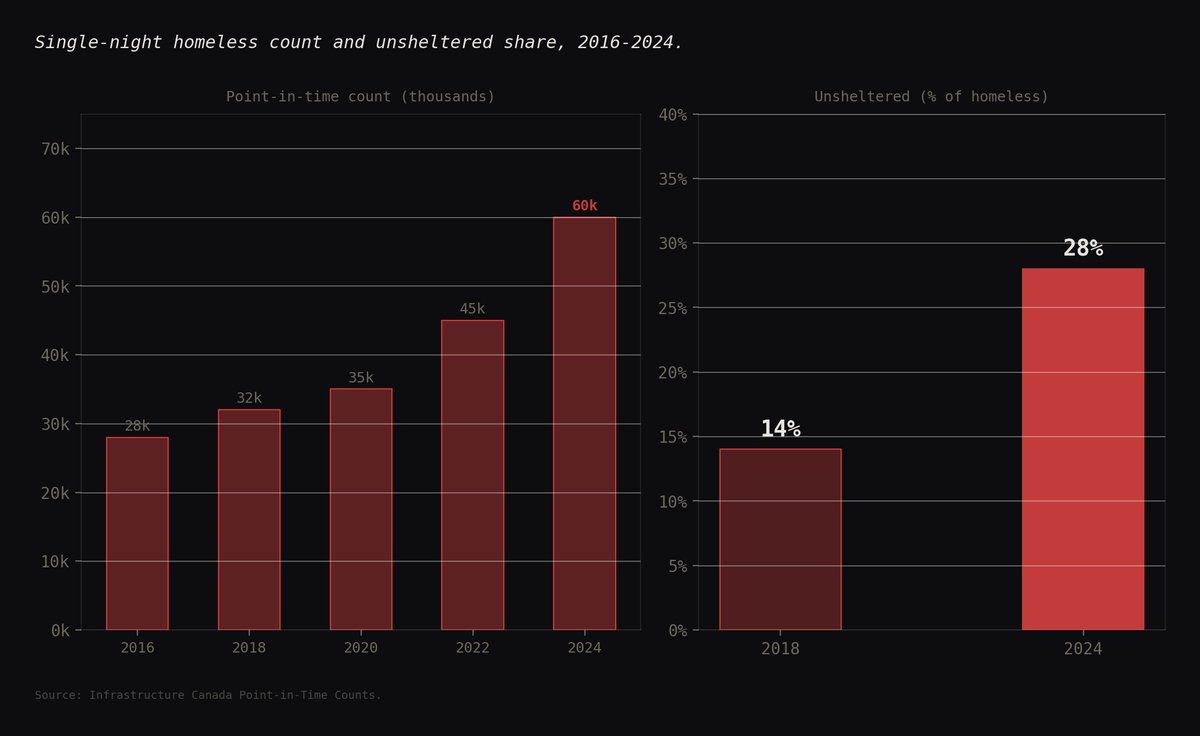
Walk through downtown Toronto, Vancouver, Ottawa, Edmonton, or Halifax today and you’ll see a street-level reality that would have been unrecognizable a decade ago. Tent encampments in public parks. People injecting drugs in broad daylight on transit platforms. The normalization has been so gradual that residents have adjusted their routes and lowered their expectations without ever being asked.
The government’s own 2025 poverty report acknowledged that “policy makers built the social safety net for a different era” and that “the current system isn’t flexible enough to adapt to meet current realities.” This is a remarkable admission from the institution responsible for the system. It is also, characteristically, paired with no meaningful plan to fix it.
The Policy Mirage: Why the Carney Government’s Proposals Won’t Fix This
Mark Carney came to office with a rare credential for a politician: actual experience in the economic domain. Governor of the Bank of Canada during the financial crisis, then head of the Bank of England during Brexit. The theory was that his technocratic seriousness would translate into the kind of structural reforms Canada needed. Instead, Budget 2025 delivered a grab bag of spending commitments, transfer payments, and sloganeering that leaves every root cause of decline untouched.
Start with the centerpiece: Build Canada Homes, the new federal agency tasked with “doubling the pace of construction” to 500,000 homes per year. The initial commitment is $13 billion and 4,000 modular homes across six sites. The Parliamentary Budget Officer has estimated the agency will deliver roughly 5,000 homes per year, or about 26,000 by 2030. Canada needs 430,000 to 480,000 annually. Build Canada Homes, at the PBO’s own estimate, covers about 1% of the target. One percent. For $3.5 billion a year. With no clear performance metrics, no mechanism to override municipal zoning fragmentation (there are over 800 residential zones in Gatineau alone), and a mandate weighed down by competing requirements to use Canadian-made and climate-friendly materials, which means by definition not the cheapest option.
B.C. developers have already expressed skepticism. The Fraser Institute points out that Ottawa can’t efficiently downsize its own office footprint despite years of effort and ample funding. The government took from 2017 to 2023 to reduce its office portfolio from 6.0 million to 5.9 million square meters. This is the institution that is going to build housing at scale. Meanwhile, the budget quietly retreated from the Liberal platform’s commitment to work with municipalities to reduce development charges by 50%. The Canadian Homebuilders Association noted this omission immediately. In Toronto, those charges exceed $130,000 per apartment and $180,000 per single-family home. Until those come down, no amount of federal prefab housing changes the math.
Then there’s the affordability strategy, which is really a transfer strategy. The renamed “Canada Groceries and Essentials Benefit” (formerly the GST Credit) gets a 25% boost for five years, providing a family of four up to $1,890 in the first year and about $1,400 thereafter. This is a cash transfer to help people afford food whose price was driven up by the same monetary and immigration policies the government pursued. It’s the economic equivalent of breaking someone’s leg and handing them a crutch. The $20 million allocated to the Local Food Infrastructure Fund to ease “immediate pressures with food banks” works out to roughly $9 per food bank user per year. The government is also developing a “National Food Security Strategy” which, true to form, promises to “strengthen domestic food production” without specifying how, when, or at what cost.
The broader fiscal framework is similarly hollow. Budget 2025 promises to “catalyze $500 billion in new investment” and to “enable $1 trillion in investments over the next five years.” These are projection numbers, not commitments. They assume that a combination of trade diversification, Buy Canadian mandates, $925 million for AI, $334 million for quantum computing, and defense spending reaching 2% of GDP will somehow attract a volume of private capital that a decade of declining competitiveness has repelled. The budget cuts 40,000 civil service positions and claims spending will grow at less than 2% annually, compared to nearly 9% over the previous decade. But it also layers on $150 billion in new measures while promising to close a $15 billion annual gap between revenue and operating spending “by Budget 2028.” These numbers don’t reconcile. They’re aspirational, and everyone in Ottawa knows it.
The most revealing initiative might be the smallest: the “Canada Strong Pass,” which gives families free or discounted access to museums, historic sites, and parks, plus a 25% VIA Rail discount for young adults. This is what the government offers a generation that can’t afford homes or children: a subsidized train ticket to look at the country they’re being priced out of. It would be satire if it weren’t real policy.
What’s missing from the agenda is everything that would actually reverse the structural decline. There is no corporate tax reform to close the competitiveness gap with the United States, where 2017 reforms sharply reduced the US rate and undid Canada’s business tax advantage. The capital gains inclusion rate hike was cancelled, which is welcome, but a defensive measure rather than a growth catalyst. There is no regulatory rollback proportionate to the problem. The interprovincial trade barriers, estimated by the IMF to be equivalent to a 21% tariff and by the Canadian Federation of Independent Business to cost up to $200 billion annually, were supposed to be eliminated by July 1, 2025. The legislation was tabled, but the barriers remain largely intact because the federal government doesn’t actually control most of them. Provinces do.
There is no plan to address the fundamental structural distortion that channels Canadian capital into real estate rather than productive assets. The financial system’s bias toward residential construction is well documented and completely unaddressed. There is no immigration reform that ties intake to housing capacity, healthcare capacity, or per-capita GDP targets. The reduced numbers in Budget 2025 are a concession to political pressure, not a structural redesign. When political winds shift, the numbers will shift back.
And there is no answer to the brain drain. The budget allocates nearly a billion dollars for AI and quantum computing, which is fine, but the people trained by those programs will walk into a labor market where their American counterparts earn double the salary, pay lower taxes, and face lower housing costs. Until the total compensation equation changes, the talent will keep leaving and no amount of “attract foreign researchers” policy language will change that. You don’t solve an outflow problem with inflow rhetoric.
The Carney government’s theory of change appears to be that confidence and stability, combined with trade diversification and defense spending, will catalyze a wave of private investment. It’s a theory well suited to a central banker’s worldview: set the conditions, signal credibility, and let private capital do the work. The problem is that Canada has been setting conditions for a decade while watching capital flow in the opposite direction. At some point, you have to ask whether the conditions themselves are the problem, not just the signaling.
The Comfortable Collapse
None of this happened overnight. None of it happened by accident. And none of it is irreversible in theory, though the window for reversal narrows with each year of inaction.
Canada’s decline is the product of specific policy choices: a deliberate preference for real estate over productive investment. An immigration system calibrated to suppress wages rather than build capacity. A healthcare system left unreformed for decades. A housing market treated as a wealth vehicle for incumbents rather than shelter for citizens. A tax and regulatory environment that repels capital and talent in favor of managed stagnation. And now, a government that has correctly diagnosed the disease and prescribed an aspirin.
The country still has extraordinary advantages. Natural resources that most nations would kill for. Proximity to the world’s largest consumer market. World-class universities and research institutions. A relatively stable political system. These assets are real. But they are being squandered at a rate that should alarm anyone paying attention.
The danger of the shifting baseline is that by the time people notice the fish are gone, the ocean has changed beyond recognition. Canada is not there yet. But it’s closer than the national conversation suggests, and the comforting myth that everything is basically fine, that Canada is still somehow doing better than it looks, is the most dangerous narrative of all.
The numbers are in. The institutions agree. The decline is structural, it is accelerating, and the only people who deny it are the ones whose incentives depend on the denial. The current government offers ambitious slogans and modest programs. It promises to “build Canada strong” while presiding over every trend that makes Canada weaker. And if history is any guide, it will continue to do so until the shifting baseline has shifted so far that the country Mark Carney inherited is unrecognizable to the country he leaves behind.
Bank of Canada. “Toward a Virtuous Circle for Productivity.” Speech, November 2025.
https://www.bankofcanada.ca/2025/11/toward-a-virtuous-circle-for-productivity/
Canadian Centre for Housing Rights. “Everything You Need to Know About Build Canada Homes.” September 22, 2025.
https://housingrightscanada.com/everything-you-need-to-know-about-build-canada-homes/
Canadian Mortgage and Housing Corporation. “Housing Starts Up 5.6% in 2025 from 2024.” January 16, 2026.
https://www.cmhc-schl.gc.ca/media-newsroom/news-releases/2026/housing-starts-december-2025
Canadian Centre for Policy Alternatives. “2025 Was Canada’s Year of Mark Carney: What Have We Learned About His Economic Policy Agenda?” January 5, 2026.
https://www.policyalternatives.ca/news-research/2025-was-canadas-year-of-mark-carney-what-have-we-learned-about-his-economic-policy-agenda/
Conservative Party of Canada. “Just the Facts: Not Building Canada Homes.” January 16, 2026.
https://www.conservative.ca/just-the-facts-not-building-canada-homes/
Department of Finance Canada. “Budget 2025: Canada Strong.” November 4, 2025.
Food Banks Canada. “HungerCount 2025: Food Banks as a Lifeline: Canada’s New Normal.” 2025.
Fraser Institute. “Waiting Your Turn: Wait Times for Health Care in Canada, 2025 Report.” 2025.
Fraser Institute. “Federal Government Wants to Build 4,000 Homes Despite Years of Real Estate Mismanagement.” 2025.
https://www.fraserinstitute.org/commentary/federal-government-wants-build-4000-homes-despite-years-real-estate-mismanagement
Information Technology and Innovation Foundation. “Underinvestment in Capital Equipment Hinders Canadian Productivity Growth.” May 27, 2025.
https://itif.org/publications/2025/05/27/underinvestment-in-capital-equipment-hinders-canadian-productivity-growth/
Liberal Party of Canada. “Our Plan.” 2025.
https://liberal.ca/plan/
Liberal Party of Canada. “Fiscal and Costing Plan.” 2025.
https://liberal.ca/cstrong/costing/
Macdonald-Laurier Institute. “Canada at a Crossroads, Volume 4: Capital Ideas.” May 20, 2025.
https://macdonaldlaurier.ca/canada-at-a-crossroads-volume-4-capital-ideas-attracting-investment-boosting-productivity/
Marion, Stéfane, and Alexandra Ducharme. “GDP per Capita: A Lost Decade.” National Bank of Canada, 2024.
OECD. “OECD Economic Surveys: Canada 2025.” 2025.
https://www.oecd.org/en/publications/2025/05/oecd-economic-surveys-canada-2025_ee18a269/full-report/raising-business-sector-productivity_443bcd88.html
Office of the Prime Minister of Canada. “Prime Minister Carney Announces New Measures to Make Groceries and Other Essentials More Affordable for Canadians.” January 26, 2026.
https://www.pm.gc.ca/en/news/news-releases/2026/01/26/prime-minister-carney-announces-new-measures-make-groceries-and-other
Office of the Prime Minister of Canada. “Prime Minister Carney Outlines Budget 2025 Measures to Buy Canadian.” November 10, 2025.
https://www.pm.gc.ca/en/news/news-releases/2025/11/10/prime-minister-carney-outlines-budget-2025-measures-buy
Policy Options (IRPP). “Build Canada Homes: The Shift to Prefabricated Housing.” February 2026.
https://policyoptions.irpp.org/2026/02/prefabricated-housing-canada/
Robson, William B.P., and Mawakina Bafale. “Canada’s Investment Crisis: Shrinking Capital Undermines Competitiveness and Wages.” C.D. Howe Institute, December 24, 2025.
https://cdhowe.org/publication/canadas-investment-crisis-shrinking-capital-undermines-competitiveness-and-wages/
Robson, William B.P., and Mawakina Bafale. “Underequipped: How Weak Capital Investment Hurts Canadian Prosperity and What to Do About It.” C.D. Howe Institute, September 12, 2024.
https://cdhowe.org/publication/canadas-capital-crisis-growing-threat-falling-business-investment-productivity/
Statistics Canada. “Canada’s Population Estimates, Fourth Quarter 2024.” 2025.
Statistics Canada. “Fertility: Fewer Babies.” The Daily, 2025.
Statistics Canada. “Labour Productivity, Quarterly Estimates.” Table 36-10-0208-01.
TD Economics. “From Bad to Worse: Canada’s Productivity Slowdown Is Everyone’s Problem.” 2024.
https://economics.td.com/ca-productivity-bad-to-worse
The Hub. “A Trillion-Dollar Gap: 12 Charts Highlighting Canada’s Capital Flight Crisis.” January 26, 2026.
https://thehub.ca/2026/01/26/a-trillion-dollar-gap-12-charts-highlighting-canadas-capital-flight-crisis/
Follow Joey Tweeets on X here, sign up for the Bombthrower mailing list here.